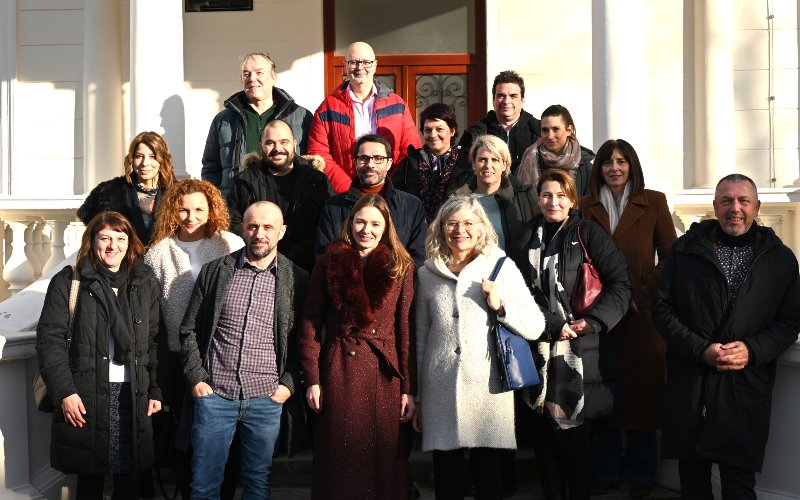
The Erasmus+ SuMoS project kick-off meeting was held
From 16
to 18 December 2024, the Erasmus+ SuMoS project kick-off meeting, fully titled
Strengthening the ecosystem for sustainable student mobility, was held,
organized by the project coordinator, the University of Zagreb, Faculty of
Organization and Informatics. The meeting was held in a hybrid format – live at
FOI and online, and was led by the project coordinator, Assoc. Prof. Katarina
Pažur Aničić, Ph.D.
The
Erasmus+ SuMoS project has a total value of 400,000.00 euros, is
implemented with the co-financing of the European Union, as part of the KA220
Collaborative Partnerships in the Field of Higher Education call, and its
duration is 3 years (01.10.2024. – 30.09.2027.). In the
aforementioned category, this project proposal was awarded the highest number
of points and was the only one awarded in that amount in Croatia.
The
kick-off meeting of the project was attended by members of all partners coming
from 5 European countries. The coordinator of the project is the University
of Zagreb Faculty of Organization and Informatics, and the partners
are ESIEA - Graduate Engineering School from France, the University
of Maribor, the Faculty of Organizational Sciences from Kranj from
Slovenia, the University of Žilina, the Faculty of Management and
Informatics from Slovakia and the University of Belgrade,
Faculty of Organizational Sciences from Belgrade from Serbia.
On the
first day of the meeting, bilateral meetings were held with representatives of
project partner teams from Slovakia and France, on the second day a meeting was
held with all partners on the project, while on the third day there were
meetings of the project management body and bilateral meetings with partners
from Slovenia and Serbia. In addition to partner meetings, a coordination
meeting of the team working on the development of the institutional student
mobility ecosystem was held. The Erasmus+ project SuMoS consists
of 5 work packages, and the goal of the project is to strengthen the
institutional ecosystem for strategic, structured and sustainable cooperation
between higher education institutions in the field of student mobility through
the development and purposeful use of green practices, digital tools and
curriculum comparison approaches.
The
expected results of the SuMoS project are:
- Recommendations for the further
development of the institutional ecosystem of student mobility that
includes green and sustainable practices, along with the development of an
innovative digital solution to raise students' awareness of their
ecological footprint
- Recommendations for the
comparison of courses and curricula at partner institutions, and the
development of a course quality label, supported by the innovative
solution of the Balanced Learning Design Planning tool (https://learning-design.eu/) developed as part of other
FOI projects (RAPIDE : https://rapide-project.eu/, iLED: https://iled-project.eu/, TRUELA: https://lalab.foi.hr/truela)
- Designed, tested and validated
innovative platform supported by artificial intelligence to support
student mobility
The project
coordinator and head of the UNIZG FOI team, Assoc. prof.
Katarina Pažur Aničić, Ph.D., said: “At FOI, we are well aware that
student mobility is one of the aspects of student life that greatly contributes
to the personal and career development of students, and consequently to
positive changes in society. Therefore, with the SuMoS project, we want to
further strengthen the existing cooperation between partner institutions in in
the field of student mobility through the development of solutions based on
green and innovative practices, including the potential of artificial
intelligence, covering all elements of the student mobility ecosystem. However,
the aim is for the project results to be widely applicable and accessible to
other higher education institutions to strengthen their capacities for
improving and increasing student mobility, in order to ultimately contribute to
the achievement of goals of increasing the number of students with mobility
experience at national and EU level.“
More
information about the project and project activities can be found on the
official SuMoS project website.